If you want to have success you should should try to absorb as much knowledge as possible right? Well, not quite. At least not only! I believe success, whether we talk at professional or personal level, derives from three factors: knowledge, competencies and attitudes. Most of the people, however, pay an excessive attention to the knowledge component while neglecting the development of the other two.
Before discussing the argument further we need to define what we mean by each of these factors. Knowledge is practical information gained through learning, experience or association.
Examples of knowledge:
- second degree equations
- human anatomy
- the rules of monopoly
- how to change a wheel
- the capital of Zimbabwe (Harare, if nothing else you learned this reading this article…)
Competencies, on the other hand, refer to the ability to perform specific tasks.
Examples of competencies:
- ability to communicate effectively
- ability to write clearly
- ability to play an instrument
- ability to solve problems
- ability to dance
The last one, attitude, involves how people react to certain situations and how they behave in general.
Examples of attitudes:
- being proactive
- being able to get along with other people
- being optimistic
- being critic towards other people
- being arrogant
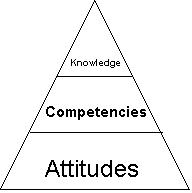
Now, if you take a look at the picture below, you will see that attitudes are the base of the pyramid. One should, therefore, focus on developing the right attitudes before passing to the competencies and to the knowledge. If you take a look at the five attitudes we used as example it is clear that one would desire to develop the first three. Distinguishing between a desirable and a problematic attitude is actually an easy task.
.
Why then do we fail to dedicate enough energy to the development of valuable attitudes? First because we might think that attitude is affected by the genetic, meaning that some people are born optimistic while others are naturally pessimistic, and there is nothing one can do to change it. This is far from the truth. While most people are naturally inclined to behave in certain ways we can still radically change or develop specific attitudes at will. Developing or changing an attitude will require much more work than developing a competence or gaining some knowledge, but that is exactly why it is also more valuable.
The second reason why people fail to focus on attitudes is because they are not aware of the benefits they would derive from that. The common sense states that the more knowledgeable someone is, the more successful he will be. While this affirmation might be true, it is only so if that person also has the right attitudes.
After developing the attitudes (which is a life long process, by the way) one should focus on competencies. Competencies come before knowledge because they are flexible and can be applied to many different situations.
Consider two different men, John and Mark, working for a financial services company. Both of them are eager to succeed so that they spend lots of time trying to grow professionally. John uses his time gaining as much knowledge as possible, he studies balance sheets, financial reports, accounting practices and the like. Mark, on the other hand, gets the knowledge that is necessary to carry out his job. Other than that he uses his time to improve his writing skills, his ability to solve problems, to come up with innovative ideas and so on. Should the financial services sector enter a downturn some day who do you think will have a harder time? Yeah, I am sure you have guessed it.
The last part of the pyramid is formed by the knowledge. Now, when I defend that prior to getting the knowledge one should develop attitudes and competencies I am not saying that knowledge is not important. Far from it, knowledge is essential. But if you consider the information and communication technologies revolution you can see that virtually anyone in the world has access to all the information ever produced. I know that information and knowledge are two different things, but the process of transforming one into the other is not that complex. What I am saying, therefore, is that the knowledge alone will not be sufficient. It does not represent a competitive advantage per se.
Summing up, success at personal or professional level will inevitably derive from three factors: attitudes, competencies and knowledge. Most people pay an excessive attention to the knowledge component while neglecting the development of competencies and attitudes. Make sure you are focusing on all the three components, it is the best strategy in the long run.
Comments are closed.